
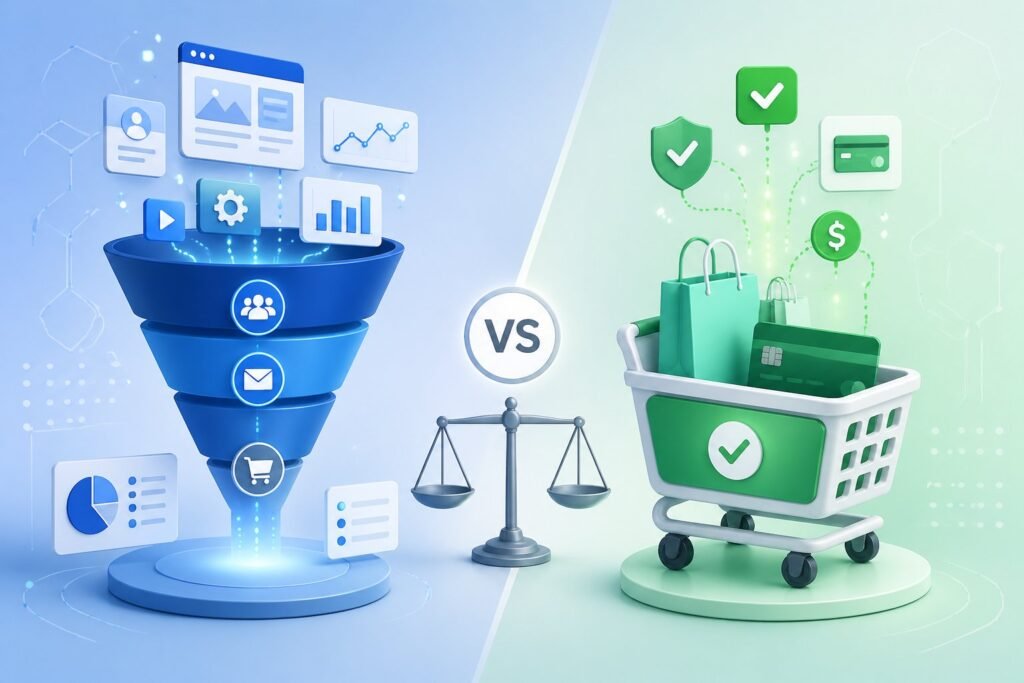
Choosing between ClickFunnels and SamCart can feel confusing when both platforms promise to boost your online sales. You need to understand what each tool does best before you invest your time and money.
One platform focuses on building complete sales funnels. The other specializes in creating smooth checkout experiences.
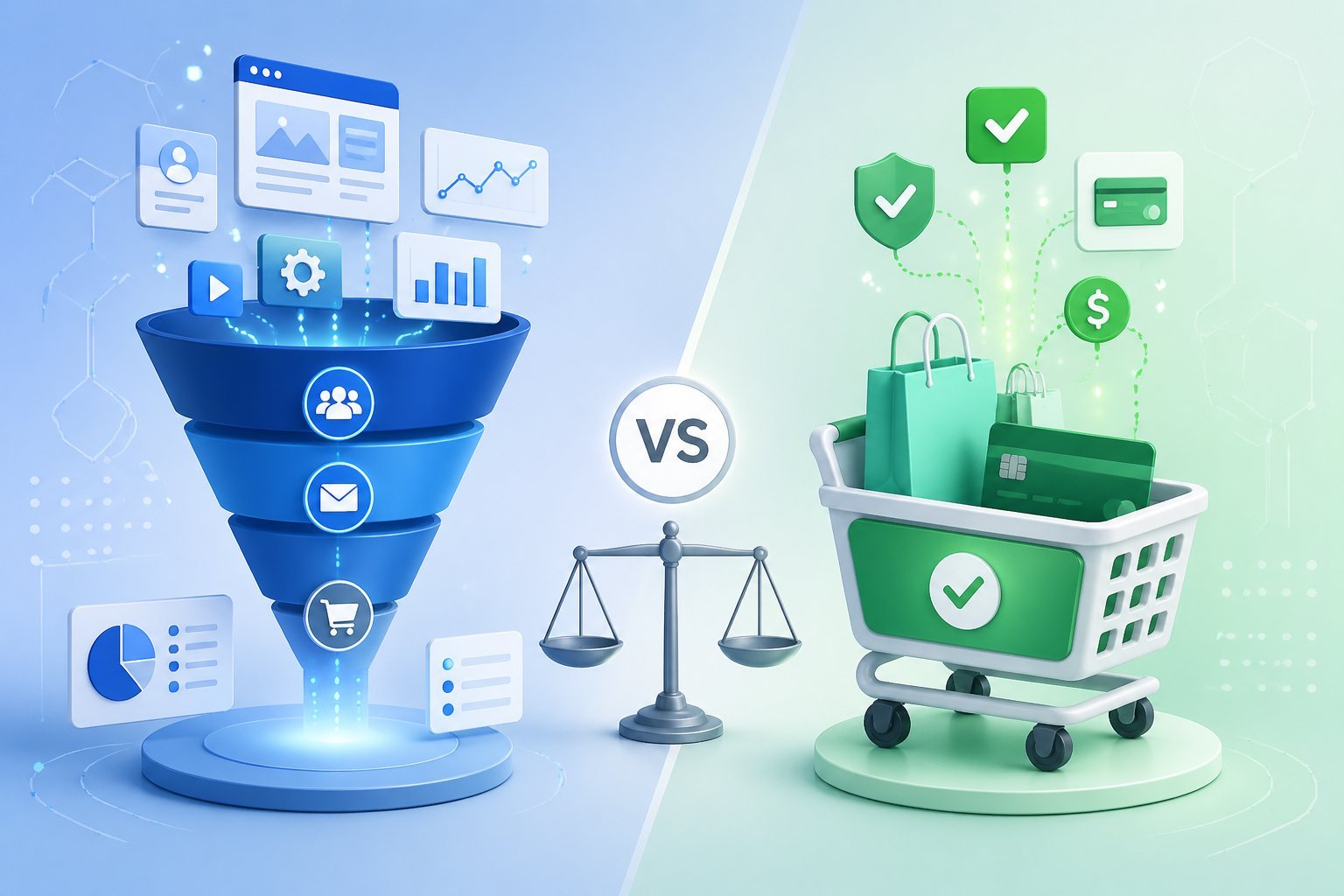
ClickFunnels is built to help you create advanced sales funnels and track customer data throughout their journey, while SamCart is designed to optimize your checkout process and make it easier for customers to complete their purchases. Both tools can help you sell online, but they solve different problems for your business.
The right choice depends on whether you need a full marketing system or a powerful checkout solution. This comparison breaks down how these platforms handle sales funnels, checkout pages, pricing, and more.
You’ll learn which features matter most for your business and which platform fits your budget and goals.
Core Differences Between ClickFunnels and SamCart
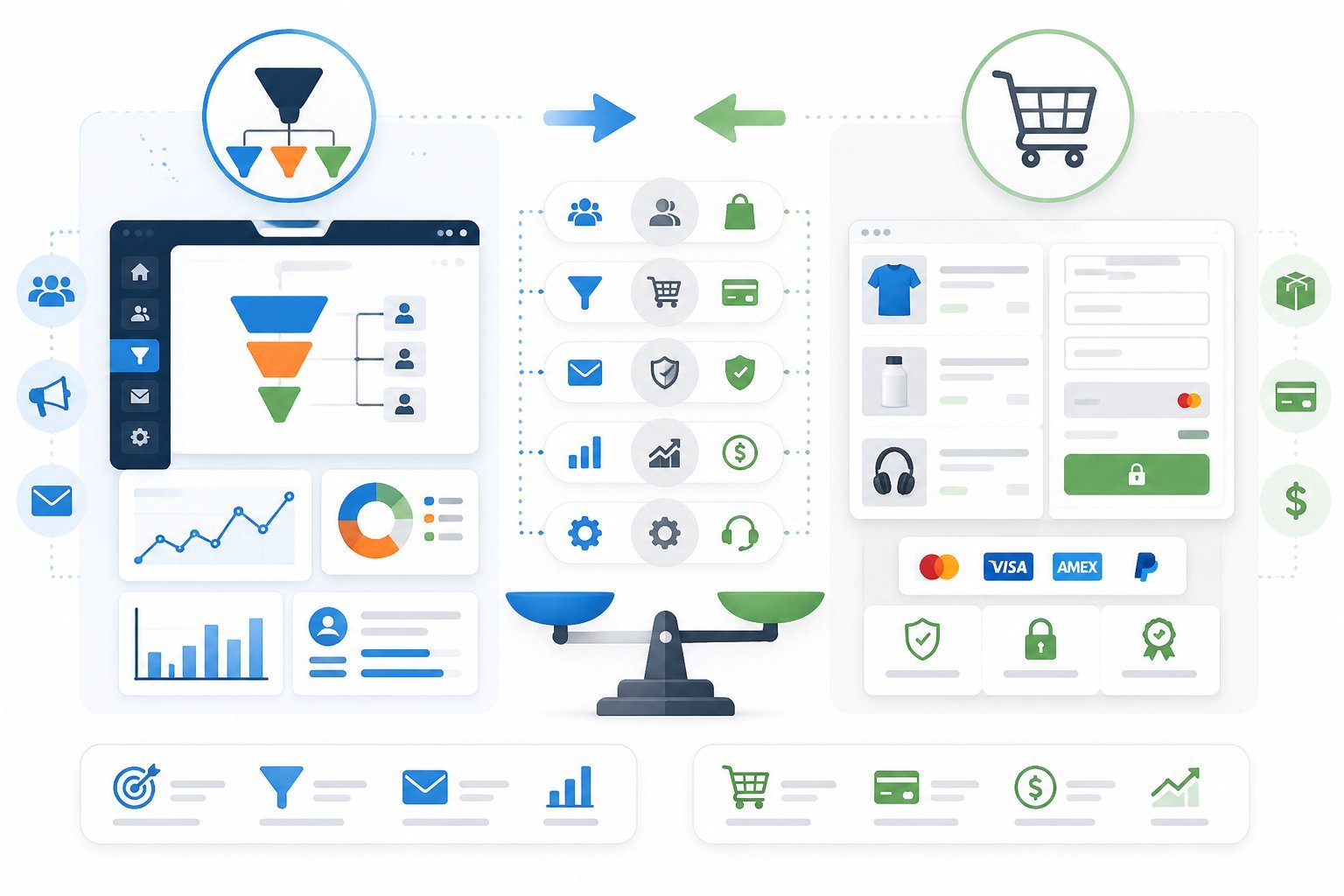
ClickFunnels operates as a complete funnel builder while SamCart focuses on perfecting your checkout platform. These tools serve different purposes even though both help you sell online.
Sales Funnel Approach and Design
ClickFunnels gives you a full sales funnel builder that lets you create multi-step funnels from start to finish. You can build landing pages, sales pages, upsell pages, and order forms all in one place.
The platform handles every stage of your customer journey. SamCart takes a different approach.
It doesn’t build complete sales funnels for you. Instead, it plugs into your existing marketing setup to handle the final step – the checkout process.
You’ll still need separate tools for your landing pages and email marketing. The funnel builder in ClickFunnels includes drag-and-drop features that let you map out complex customer paths.
You can add multiple steps, create different paths based on customer actions, and track people through your entire funnel. SamCart keeps things simpler by focusing only on getting people from “add to cart” to “purchase complete.”
Platform Focus: All-in-One vs. Checkout Optimization
ClickFunnels works as an all-in-one platform. You get email marketing, website hosting, course creation, and analytics bundled together.
This means fewer tools to manage and less integration work. SamCart specializes in checkout optimization.
It offers features like one-click upsells, order bumps, and payment plan options. The platform makes it easy for your customers to buy by reducing friction at checkout.
You get express checkout options and multiple payment methods that can increase your conversion rates. The ease of use differs between them.
SamCart is simpler to set up because it does less. You can have a checkout page running in minutes.
ClickFunnels has more features, which means a steeper learning curve. You’ll spend more time learning the system but get more capabilities.
Ideal Use Cases for Each Platform
You should pick ClickFunnels when you need complete control over your sales funnels. It works well if you’re building an online business from scratch or want everything in one place.
Coaches, consultants, and course creators who need landing pages, email sequences, and membership areas will benefit most. SamCart makes sense when you already have traffic and just need better checkout pages.
If you’re selling digital products, physical goods, or subscriptions and want to maximize your conversion rates, it’s a good fit. Small business owners who use separate tools for marketing but want a powerful checkout platform will find it useful.
Sales Funnel and Checkout Page Capabilities
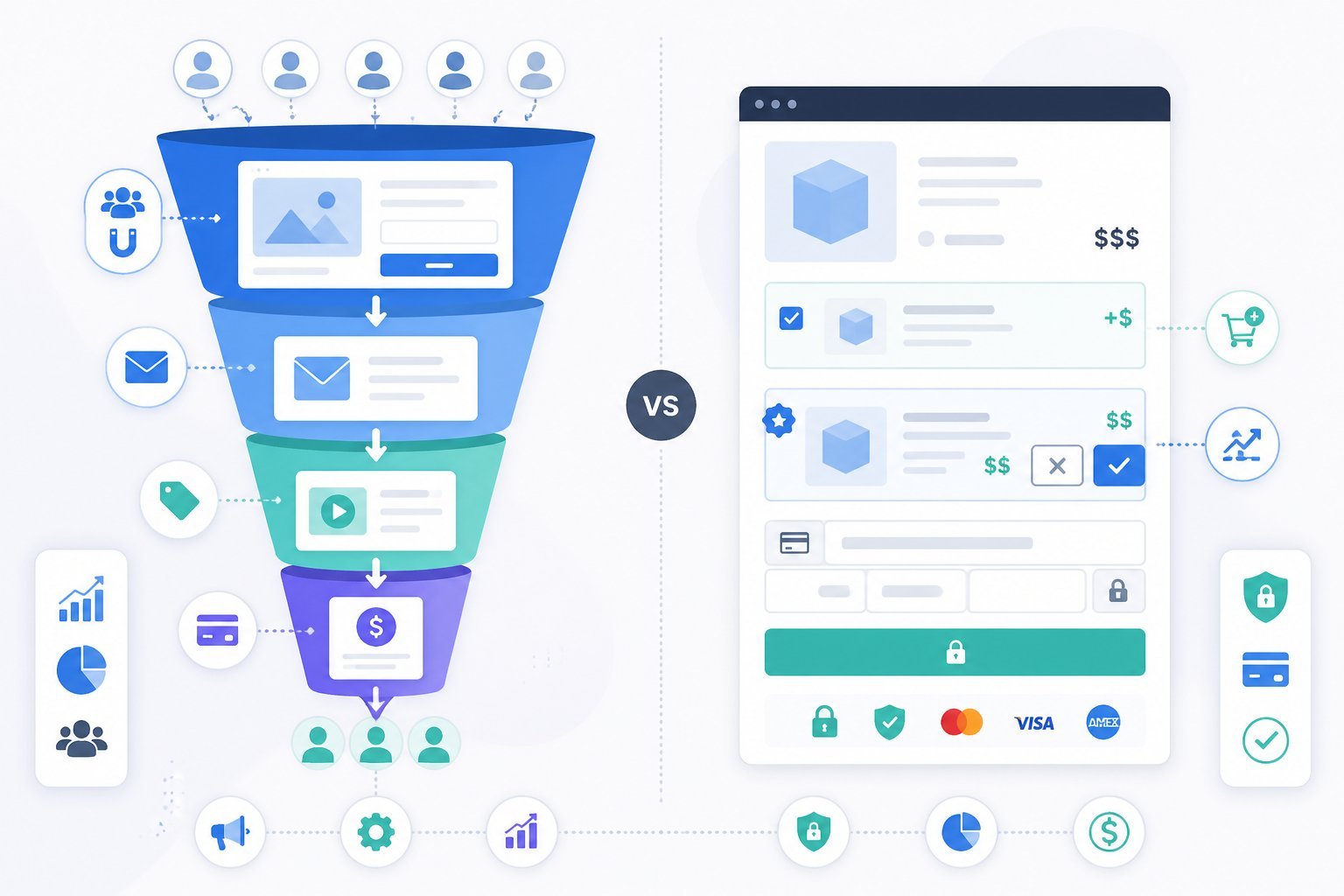
ClickFunnels specializes in multi-step funnel creation while SamCart focuses on checkout optimization and conversion. Both platforms let you build landing pages and sales pages, but they handle funnel complexity and checkout experiences differently.
Building and Customizing Funnels
ClickFunnels built its reputation as a funnel builder. You can create complex, multi-step funnels with opt-in pages, lead magnets, email sequences, and nurture campaigns.
The platform gives you templates for webinar funnels, product launch funnels, and lead generation sequences. SamCart approaches funnel creation differently.
Instead of requiring you to map out every step manually, the platform uses AI to build your funnels based on proven conversion data. You tell it what you’re selling, and it creates the structure for you.
Key differences in funnel building:
- ClickFunnels requires manual setup of each funnel step
- SamCart uses AI trained on $7B+ in transaction data to automate funnel creation
- ClickFunnels offers more templates for complex lead nurture sequences
- SamCart gets you from idea to live funnel faster with AI assistance
If you need elaborate multi-step funnels with lots of branching logic, ClickFunnels gives you more manual control. If you want to launch faster with less technical work, SamCart’s AI-powered approach handles the heavy lifting.
Landing Pages and Sales Pages
Both platforms let you build landing pages and sales pages without coding. ClickFunnels provides a drag-and-drop page builder with pre-made templates.
You choose a template, customize the design, and add your copy. SamCart’s AI page builder works differently.
It doesn’t just give you a blank template. The AI writes your sales copy, designs your layout, and builds your page based on what’s converted across billions in creator sales.
You can still customize everything, but you start with proven copy and design instead of a blank canvas. The page builder in ClickFunnels gives you full design flexibility.
SamCart’s AI builder prioritizes speed and conversion data over unlimited customization options.
Checkout Pages and Experiences
This is where the biggest difference shows up. SamCart specializes in checkout optimization.
The platform’s checkout pages convert at 3-4x the industry average because they’re engineered specifically for digital product sales. SamCart’s high-converting checkout includes:
- Single-page checkout with minimal form fields
- Order bumps displayed at purchase moment
- One-click upsells that don’t require re-entering payment info
- Multiple payment options (credit cards, PayPal, Apple Pay, buy-now-pay-later)
ClickFunnels has checkout pages and shopping cart functionality, but it’s part of a broader funnel system rather than the core focus. The checkout forms work fine, but the platform doesn’t publish conversion benchmarks like SamCart does.
Your checkout page builder choice matters because that’s where revenue happens. SamCart’s checkout page builder reduces friction at every step, which directly impacts how many visitors become paying customers.
Conversion Tools and Revenue Optimization
Both platforms include tools to increase what customers spend per transaction, but they handle conversion optimization differently. SamCart focuses on checkout-specific features that reduce friction, while ClickFunnels emphasizes full-funnel conversion across multiple pages.
One-Click Upsells and Order Bumps
One-click upsells let you offer additional products after someone completes a purchase without requiring them to re-enter payment information. Both SamCart and ClickFunnels include this feature.
SamCart places order bumps directly on the checkout page as simple checkboxes. These are small add-ons customers can select before completing their main purchase.
Data from SamCart shows creators using order bumps see an average 42% increase in first-day revenue. ClickFunnels also supports one-click upsells and order bumps, but they’re part of a larger funnel sequence.
You can create multiple upsell pages after the initial purchase, which works well for higher-ticket offers or product bundles. The trade-off is more steps in your funnel, which can create additional points where customers drop off.
The main difference is speed and simplicity. SamCart’s approach adds revenue at the point of purchase with minimal friction.
ClickFunnels gives you more control over the upsell sequence but requires more setup.
Cart Abandonment Solutions
Cart abandonment happens when someone starts checkout but doesn’t complete it. This is where most online businesses lose money.
SamCart addresses cart abandonment through checkout optimization rather than recovery emails. Their single-page checkout design removes common friction points: fewer form fields, faster load times, and multiple payment options including Apple Pay and buy-now-pay-later services.
The goal is preventing abandonment before it happens. ClickFunnels handles cart abandonment through follow-up sequences.
You can set up automated emails to people who started but didn’t finish checkout. This requires integration with an email platform and additional setup work.
Both approaches work, but they solve the problem at different stages. SamCart prevents abandonment through a faster checkout.
ClickFunnels tries to recover abandoned carts after someone leaves.
A/B and Split Testing Features
Both platforms include A/B testing capabilities, but with different focus areas. SamCart’s A/B testing works primarily on checkout pages and product pages.
You can test different headlines, layouts, pricing displays, and order bump placements. The platform tracks which version produces more completed purchases, not just clicks.
ClickFunnels offers A/B split testing across entire funnels. You can test different page sequences, opt-in forms, and sales page variations.
This gives you more testing flexibility if you’re running complex multi-step funnels. The limitation with ClickFunnels is that testing entire funnels requires more traffic to reach statistical significance.
SamCart’s checkout-focused testing produces actionable results faster because you’re testing the final conversion point.
Increasing Average Order Value
Average order value is the total revenue divided by number of orders. Small increases here compound quickly.
SamCart increases average order value through three specific tools: order bumps at checkout, one-click upsells immediately after purchase, and subscription billing options. These work together without adding friction.
The platform’s data shows these features can increase what customers spend by 3-4x compared to a basic checkout. ClickFunnels approaches average order value through funnel strategy.
You build ascending value ladders where each funnel step presents a higher-priced offer. This works well for businesses with multiple product tiers or coaching packages at different price points.
The practical difference comes down to complexity versus conversion rate. ClickFunnels gives you more options to present different offers but requires customers to move through multiple pages.
SamCart keeps everything on fewer pages, which maintains higher completion rates but gives you fewer opportunities to present new offers.
Product Support: Digital, Physical, and Membership Options
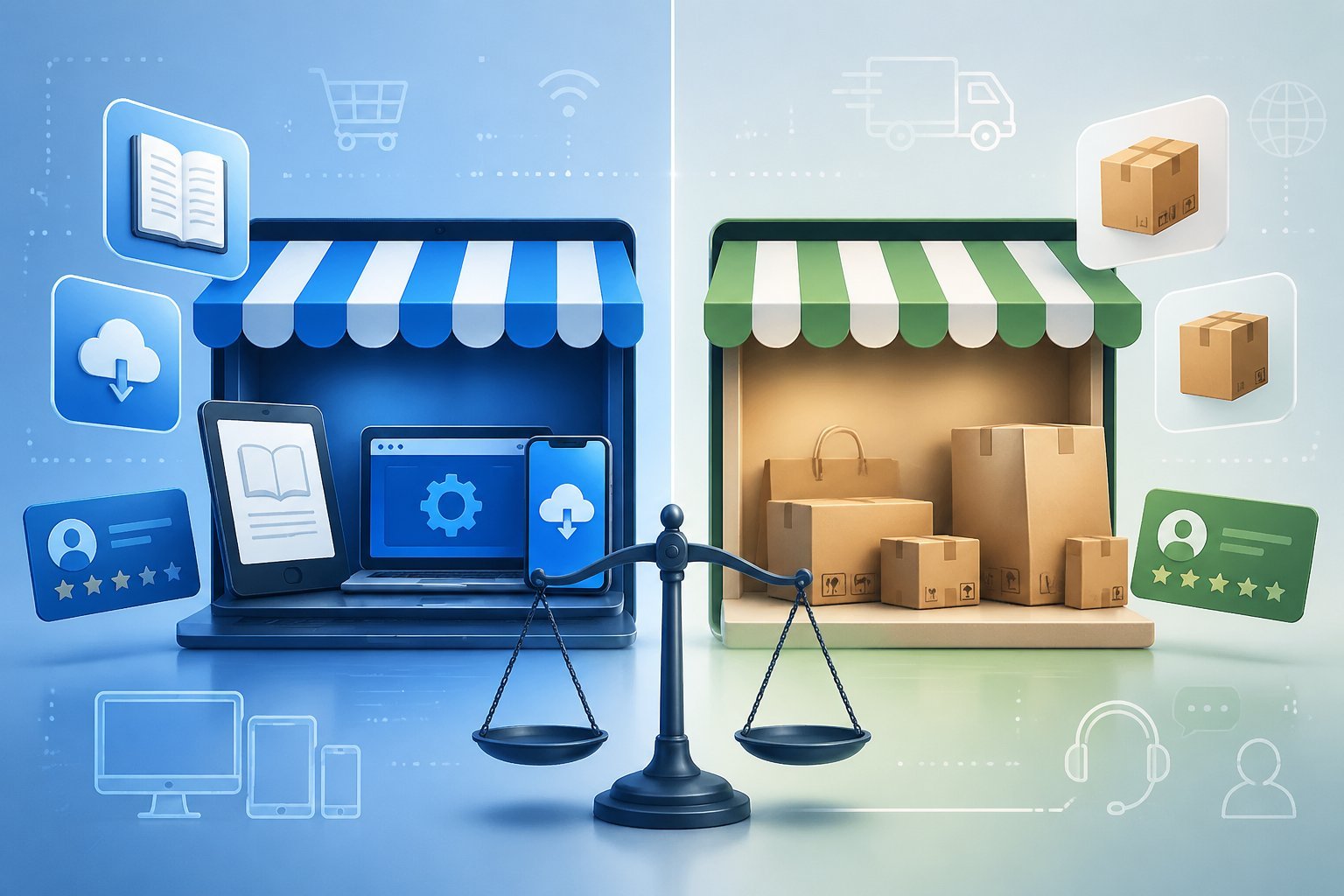
Both platforms handle digital products well, but they differ in how they support physical items and memberships. SamCart offers native tools for all three product types, while ClickFunnels requires higher-tier plans for some features.
Selling Digital Products and Online Courses
SamCart makes it easy to sell digital products right out of the box. You can deliver ebooks, PDFs, video courses, and downloads automatically after purchase.
The platform includes built-in course hosting, so you don’t need to pay for a separate membership plugin or third-party course builder. ClickFunnels also supports digital product sales and includes course creation tools.
However, the full course builder features are only available on higher-priced plans. If you’re on the basic plan, you’ll have limited options for structuring your online courses.
Both platforms let you create product pages optimized for conversions. SamCart’s AI can write and design these pages for you based on your product details.
ClickFunnels gives you templates, but you’ll need to customize them yourself. For product launches, both platforms offer countdown timers, scarcity tools, and launch sequences to create urgency around your offers.
Membership and Subscription Features
SamCart includes native membership site functionality on all plans. You can create member-only content areas, drip course lessons over time, and manage subscriber access without any additional plugins.
The platform also offers Subscription Saver, which automatically tries to recover failed payments before canceling memberships.
ClickFunnels provides membership sites too, but access depends on your plan level. The basic tier has limited membership features, while full functionality comes with Pro or higher plans.
Both platforms handle recurring billing for subscription products. You can set up monthly, yearly, or custom payment schedules and manage cancellations through each dashboard.
Physical Product Capabilities
SamCart supports physical products alongside digital offerings. You can add shipping options, calculate rates, and manage inventory all from one platform.
This works well if you sell a mix of physical items like books or workbooks with your digital courses.
ClickFunnels also handles physical product sales and includes shipping calculators. The platform gives you more flexibility for complex product catalogs.
Both platforms integrate with fulfillment services if you’re scaling physical product operations.
Integrations and Automation Capabilities
Both platforms connect with popular email marketing services and third-party apps. They take different approaches to automation and affiliate management.
ClickFunnels offers more built-in automation features, while SamCart focuses on streamlining checkout integrations.
Email Marketing Integrations
You can connect both platforms to major email marketing services like Mailchimp, ActiveCampaign, GetResponse, Aweber, and Drip. ClickFunnels includes built-in email automation through its Follow-Up Funnels feature.
This lets you create automated email sequences directly inside the platform without needing a separate service.
SamCart doesn’t include native email automation tools. You’ll need to connect it to your existing email marketing platform to send automated messages.
The setup process is straightforward, and SamCart works well with most popular email services.
ClickFunnels gives you more control over marketing automation workflows. You can trigger emails based on customer actions, segment your audience, and build complex automation sequences.
SamCart handles the basics but relies on your connected email platform for advanced automation features.
Third-Party App Connections
ClickFunnels connects to hundreds of third-party apps through direct integrations and Zapier. You can link your funnels to CRM systems, payment processors, webinar platforms, and analytics tools.
The platform includes native integrations for commonly used business tools.
SamCart also works with Zapier to expand its integration options. The platform focuses heavily on payment processing integrations to give your customers multiple checkout options.
You can connect accounting software, membership platforms, and delivery services.
Zapier acts as a bridge for both platforms when direct integrations aren’t available. This gives you flexibility to connect almost any tool you need for your business.
Affiliate Program and Management Tools
ClickFunnels includes Backpack, a built-in affiliate management system. You can create and run your own affiliate program without paying for separate software.
The Affiliate Center lets you track commissions, manage affiliates, and provide marketing materials to your partners.
SamCart offers affiliate tools but with less depth than ClickFunnels. You can set up basic affiliate programs and track referrals.
The platform handles commission tracking and payment processing for your affiliates.
ClickFunnels gives you more options for building a strong affiliate program. Backpack includes features like multi-tier commissions and sticky cookies.
SamCart works fine for simple affiliate programs but may require third-party tools for advanced features.
Pricing, Plans, and Free Trials
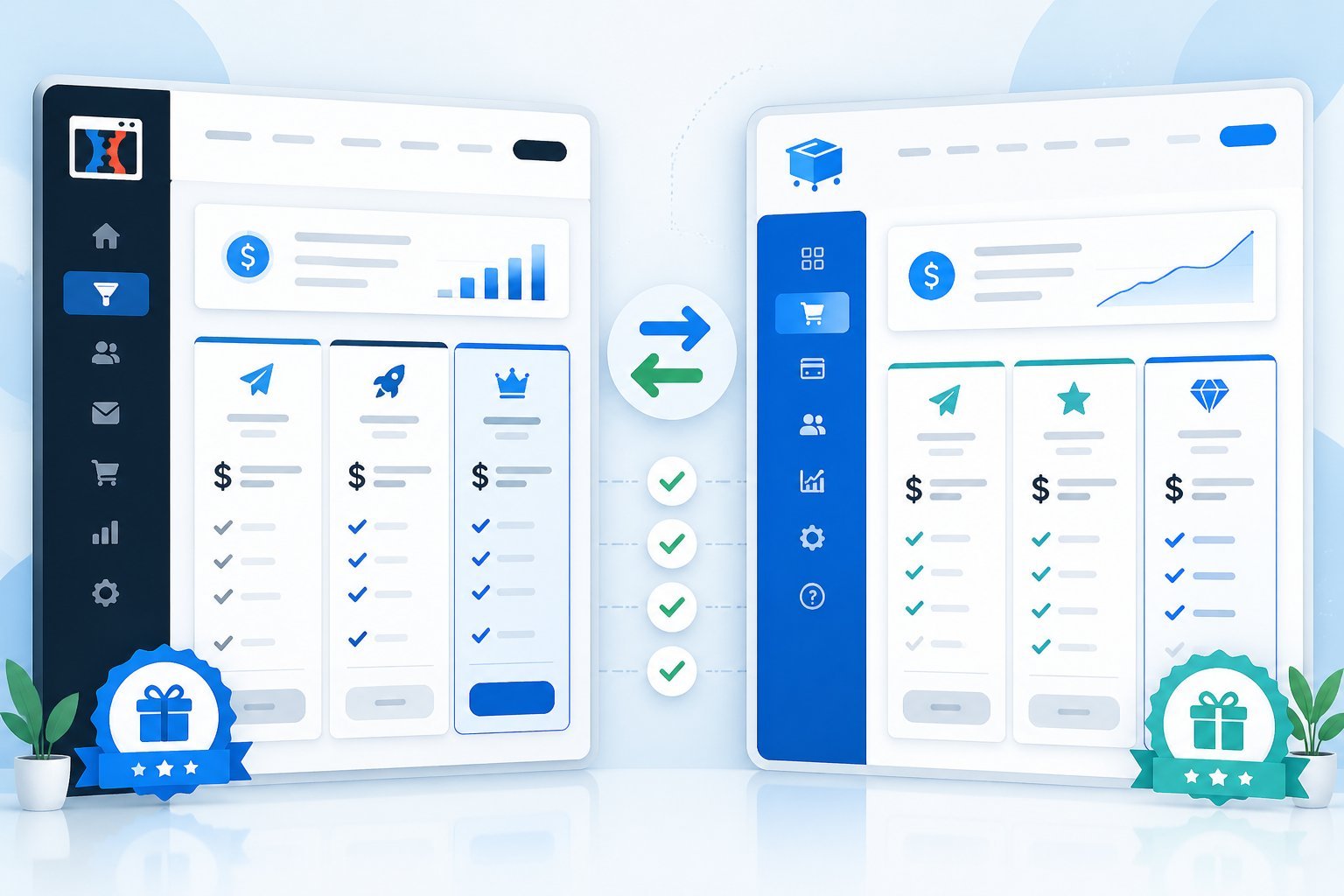
ClickFunnels costs more than SamCart. The pricing difference reflects what each platform focuses on.
Both offer annual billing options that reduce your monthly cost and provide trial periods to test the software.
Comparison of Pricing Plans
SamCart starts at $59 per month when you pay annually. The Launch plan covers basic checkout features for small businesses.
The Grow plan costs $119 per month and adds advanced selling tools. The Scale plan runs $299 per month for high-volume sellers who need extra features.
ClickFunnels pricing begins at $81 per month with annual billing. The Basic plan gives you core funnel building tools.
The Pro plan costs $297 per month and expands your limits. The Funnel Hacker plan reaches $497 per month for larger operations.
| Platform | Entry Plan | Mid-Tier Plan | Top Plan |
|---|---|---|---|
| SamCart | $59/month | $119/month | $299/month |
| ClickFunnels | $81/month | $297/month | $497/month |
Features Included in Each Plan
SamCart’s Launch plan includes unlimited products, pages, and courses. The Grow plan adds order bumps, cart abandonment tracking, and post-order upsells.
The Scale plan unlocks subscription payment protection, an affiliate center, and custom API integrations.
ClickFunnels limits you differently. The Basic plan allows 20 funnels, one domain, and 10,000 contacts.
The Pro plan increases this to 100 funnels, three domains, and 25,000 contacts. The Funnel Hacker plan removes funnel limits and supports 200,000 contacts across nine domains.
All ClickFunnels plans include unlimited email sequences and workflows. SamCart focuses on checkout optimization rather than email marketing across all tiers.
Free Trials and Tier Options
Both platforms offer free trials to test their features. SamCart provides a standard 14-day trial.
ClickFunnels also gives you 14 days to explore the platform. Neither platform has a permanently free plan.
You need to pick a paid subscription after your trial ends. Some promotions extend SamCart’s trial to 30 days.
Payment plans work differently on each platform. SamCart lets you offer customers monthly and annual membership options, free trials, and installment plans.
ClickFunnels supports similar subscription models through its funnel system.
Analytics, Support, and User Experience
Both platforms provide tracking tools and help resources. They differ in how much detail you get and how fast you can get assistance when problems come up.
Reporting and Analytics Dashboards
SamCart gives you detailed analytics that show exactly where your money comes from. You can track revenue by product, conversion rates at each step, and how well upsells and order bumps perform.
The dashboard breaks down which traffic sources bring paying customers versus just browsers.
ClickFunnels provides analytics focused on funnel performance. You can see where people drop off in your multi-step funnels and which pages convert best.
The data helps you spot bottlenecks in your sales process. SamCart’s analytics center on checkout conversion and revenue optimization, while ClickFunnels tracks the entire funnel journey from landing page to purchase.
If you need to understand what happens at the point of sale, SamCart gives you more granular data. If you want to map out a complex customer journey, ClickFunnels shows you the full path.
Customer Support and Knowledge Base
SamCart offers email support and live chat during business hours. Response times typically range from a few hours to one business day.
Their knowledge base includes step-by-step guides for common tasks like setting up products and configuring payment processors.
ClickFunnels provides email support with priority access for higher-tier plans. The Funnel Hacker plan at $297/mo gets you faster responses.
Their help center has extensive documentation and video tutorials covering funnel building basics.
Both platforms maintain active knowledge bases. You can usually find answers to technical questions without contacting support.
Community and User Resources
ClickFunnels has a large established community. The official Facebook group has thousands of members sharing funnel templates and marketing strategies.
You’ll find plenty of third-party courses and YouTube tutorials from funnel-building experts.
SamCart’s community is smaller but focused on digital product creators. Their Facebook group connects course creators and coaches who share what’s working for checkout optimization and product launches.
The size of ClickFunnels’ community means more resources and peer support. SamCart’s tighter community offers more targeted advice for digital product businesses specifically.
Payment and Checkout Options
Both platforms handle payments differently. SamCart focuses heavily on checkout optimization while ClickFunnels offers basic payment processing as part of its broader funnel system.
Supported Payment Gateways
ClickFunnels integrates with major payment gateways including Stripe and PayPal. You can connect these payment processors directly to your funnels without needing third-party tools.
SamCart works with Stripe and PayPal as well. The platform also supports additional payment gateways depending on your subscription plan.
Both options give you the flexibility to accept credit cards and process transactions securely.
The key difference is how each platform handles these integrations. SamCart builds its entire system around payment processing, making it easier to manage different payment methods.
ClickFunnels treats payments as one feature among many in your sales funnel.
Digital Wallets and Payment Methods
SamCart provides more options for how customers can pay. You can set up one-time payments, subscription billing, and payment plans all from the same checkout page.
This gives your customers flexibility in how they purchase from you.
ClickFunnels supports recurring billing and payment plans too. However, the setup process is more complex because you need to configure these options within your funnel structure.
Both platforms let customers use digital wallets through their Stripe and PayPal integrations. This means people can check out using Apple Pay, Google Pay, and other modern payment options that speed up the buying process.
Customizable Checkout Experiences
SamCart excels at customizable checkout pages. You get features like order bumps, upsells after purchase, and cart abandonment tracking.
The platform offers express checkout, pop-up checkout, and embedded checkout options to reduce friction during the buying process.
ClickFunnels provides checkout customization, but it’s more limited. You can add order bumps and upsells to your funnels, but the options aren’t as extensive as SamCart’s.
Some users find ClickFunnels’ checkout customization clunky and complicated to set up.
If your main goal is creating smooth checkout experiences with lots of payment flexibility, SamCart’s checkout-focused design gives you more tools. ClickFunnels works better when you need checkout as part of a larger sales funnel strategy.
Templates, Customization, and Ease of Use
ClickFunnels offers hundreds of pre-built funnel templates while SamCart focuses on optimized checkout templates.
Both platforms let you customize designs without coding, but they take different approaches to building and editing pages.
Funnel and Page Templates
ClickFunnels provides over 100 funnel templates for different business needs. You get templates for webinars, product launches, lead generation, and membership sites.
Each template includes multiple pages that work together as a complete funnel. The templates cover landing pages, sales pages, order forms, and thank you pages.
You can pick a template and customize it to match your brand colors and style.
SamCart takes a different route by focusing mainly on checkout page templates. You get fewer template options overall, but the checkout templates are designed specifically to boost conversions.
The platform includes templates for one-time purchases, subscriptions, and payment plans.
SamCart also offers sales page templates, though the selection is smaller than ClickFunnels. The main strength here is the checkout page builder, which lets you add order bumps and upsells easily.
Drag-and-Drop Builders
ClickFunnels uses a drag-and-drop page builder that lets you move elements around your pages. You can add text, images, videos, buttons, and forms by dragging them onto the page.
The builder gives you control over layouts and designs. The customization options are extensive, but this can make things feel complicated at first.
You might spend extra time learning where everything is and how the editor works. SamCart offers a simpler builder that focuses on checkout pages.
You can customize fields, add your logo, change colors, and adjust the layout. The interface is more straightforward because it handles fewer types of pages.
Both platforms let you edit without touching code. SamCart’s streamlined approach means you can set up a checkout page faster than building a full funnel in ClickFunnels.
Ease of Onboarding and Use
SamCart is easier to learn because it focuses on one main task: creating checkout pages. You can get your first checkout page live within an hour of signing up.
The dashboard is clean and shows you exactly what you need to do next.
ClickFunnels has a steeper learning curve due to its many features. New users often need to watch tutorials to understand how to build funnels properly.
The platform tries to help with onboarding guides, but you still need time to get comfortable with all the tools.