
Choosing between ClickFunnels and ConvertKit can feel confusing because they seem similar at first glance. Both tools help you build an online business, but they take very different approaches.
ClickFunnels focuses on creating complete sales funnels with landing pages, checkout systems, and upsells, while ConvertKit (now called Kit) specializes in email marketing and audience building for creators.
The right choice depends on what you need most. If you want to build a full sales system that moves people from stranger to customer, ClickFunnels offers more features for that goal.
But if you’re a blogger, podcaster, or content creator who wants to grow an email list and connect with your audience, ConvertKit gives you better tools for email automation and subscriber engagement.
This guide will walk you through the key differences between these platforms. You’ll learn about their features for building landing pages, managing email campaigns, handling sales, and tracking results.
Core Differences Between ClickFunnels and ConvertKit
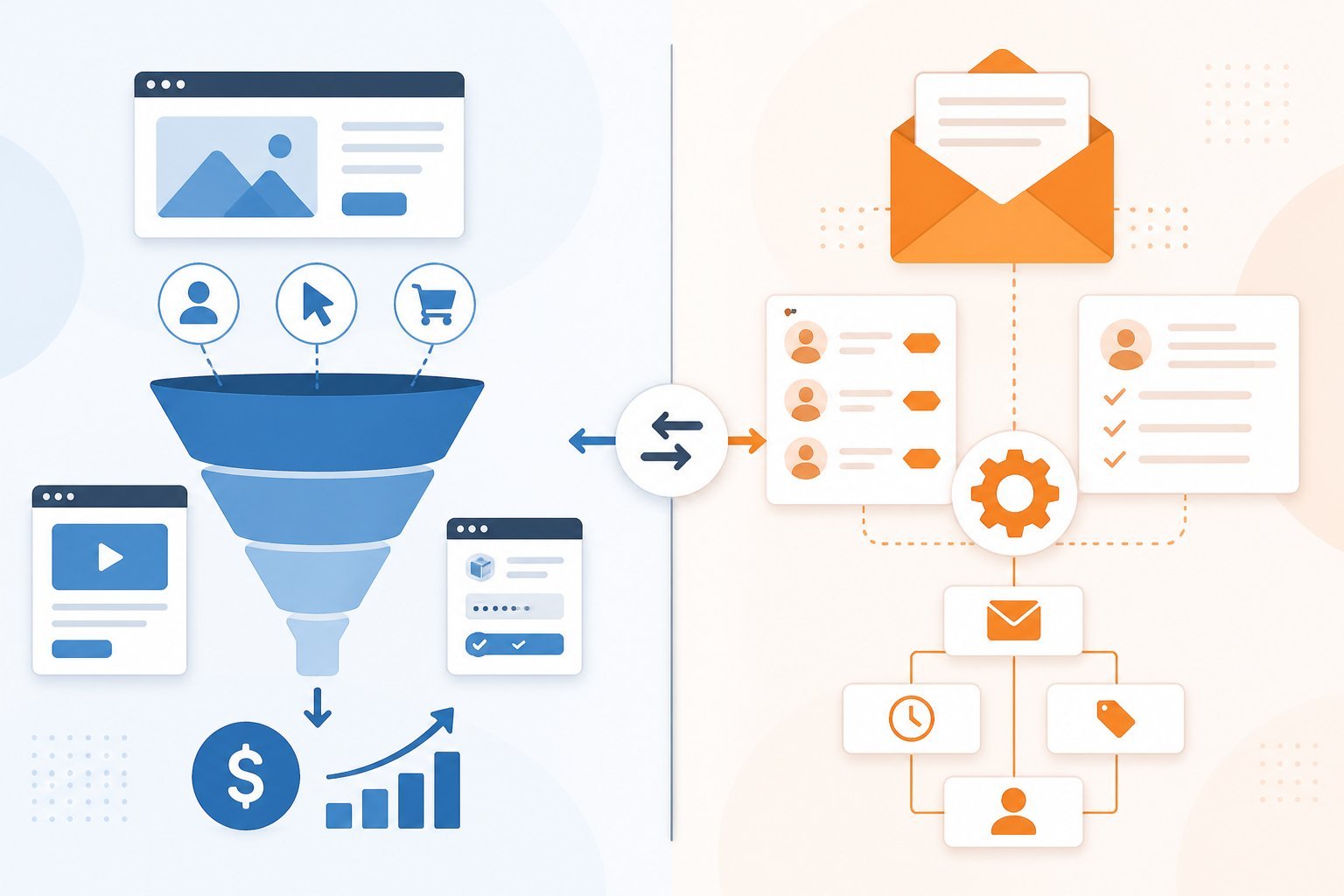
ClickFunnels and ConvertKit serve different core purposes in your marketing toolkit. ClickFunnels helps you build complete sales funnels to sell products, while ConvertKit focuses on email marketing and building relationships with your audience.
Purpose and Approach
ClickFunnels is a sales funnel builder designed to turn visitors into customers. You use it to create landing pages, checkout pages, and complete sales processes that guide people toward making a purchase.
The platform focuses on conversion rates and revenue metrics. ConvertKit (now called Kit) is an email marketing platform built specifically for creators.
You use it to send newsletters, manage your subscribers, and build automated email sequences. The platform emphasizes audience growth and engagement metrics like open rates and click-through rates.
When you use ClickFunnels, you’re building a path to sell something. When you use ConvertKit, you’re building relationships through email.
Many entrepreneurs use both tools together because they solve different problems.
Target Users and Ideal Use Cases
ClickFunnels works best for entrepreneurs and marketers who need to sell products or services online. You’ll find it useful if you’re selling courses, physical products, coaching packages, or running webinars.
The platform fits businesses that focus on direct sales and immediate conversions. ConvertKit is designed for creators like authors, bloggers, podcasters, and content creators.
You’ll get the most value from it if you publish regular content and want to build a loyal email list. Coaches who prioritize relationship-building over quick sales also prefer ConvertKit.
If you’re launching a new product and need a complete sales system, ClickFunnels is your tool. If you’re an author who wants to stay connected with readers through weekly emails, ConvertKit is the better choice.
Ease of Use and User Experience
ClickFunnels has a steeper learning curve because it includes more features. You’ll need time to understand funnel building, page design, and sales optimization.
The drag-and-drop editor is powerful but can feel overwhelming at first. The platform provides templates that help speed up the process.
ConvertKit offers a simpler interface focused on email marketing tasks. You can set up your first email sequence within minutes.
The platform removes unnecessary features to keep things straightforward for creators who just want to send good emails. Your technical skill level matters here.
If you’re comfortable learning complex software, ClickFunnels gives you more control. If you want something simple that works right away, ConvertKit gets you started faster.
Landing Pages, Forms, and Funnel Building
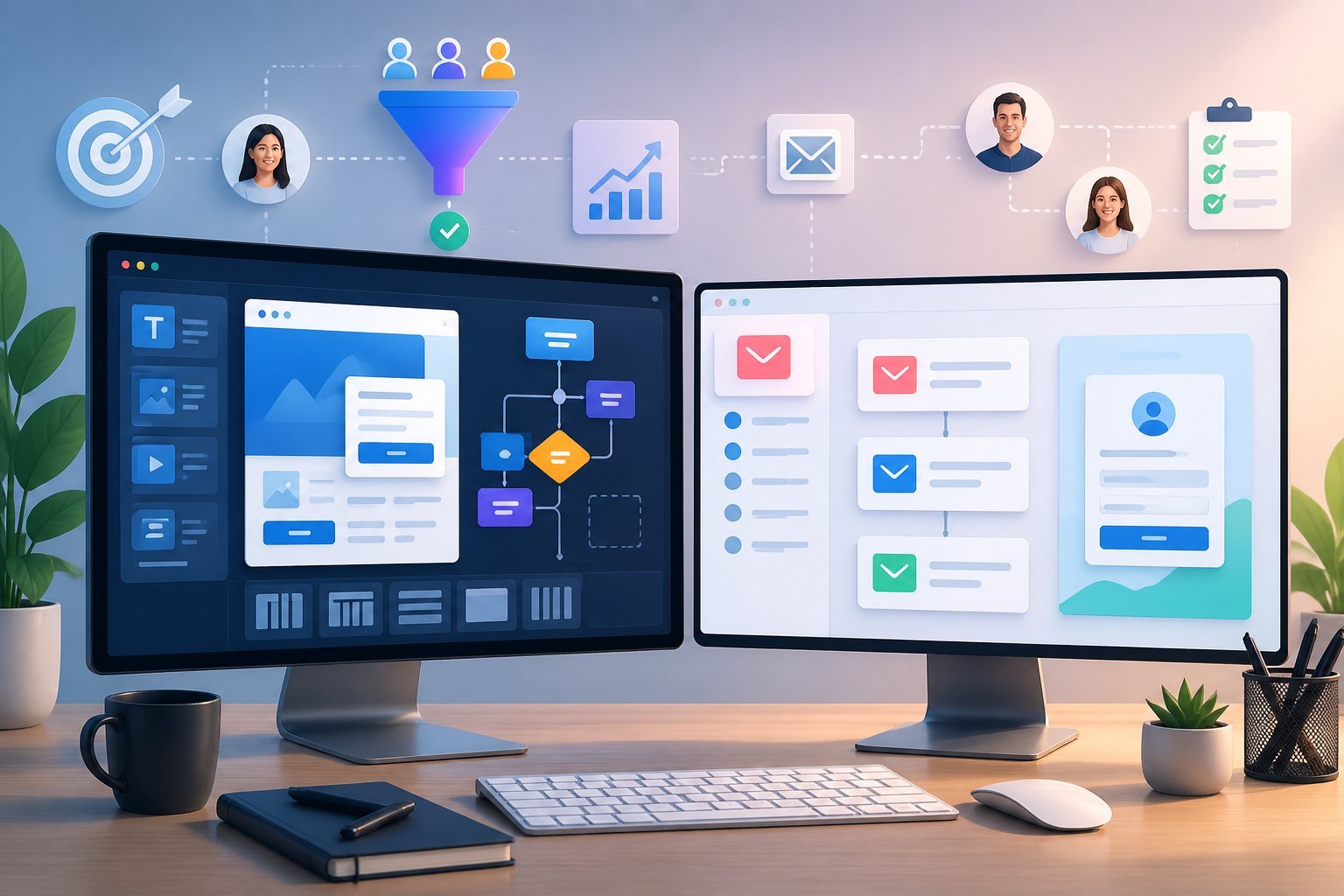
ClickFunnels provides more design flexibility and funnel-building power, while ConvertKit offers simpler tools focused on basic lead capture for email marketing.
Landing Page Builders
ClickFunnels gives you a drag-and-drop editor with extensive customization options. You can add elements like CTA scroll stoppers, FAQs, pop-ups, and animations to your landing pages.
The page editor lets you control padding, positioning, borders, and shadows for every element. ConvertKit’s landing page builder is much more basic.
You can’t drag and drop elements around the page. Instead, you’re limited to adding simple components like images, icons, headings, and numbered lists.
With ClickFunnels, you can see your changes in real-time as you edit. You can also customize how your pages look on mobile versus desktop.
ConvertKit lets you adjust background colors, font types, and sizes, but that’s about it. If you know CSS and HTML, ConvertKit does let you create custom templates from scratch.
Form Creation and Customization
Both platforms let you build opt-in forms for lead capture. ClickFunnels offers more design control over your forms through its drag-and-drop editor.
You can customize every visual aspect to match your brand. ConvertKit provides simple form creation that works well for basic needs.
You can create opt-in forms and registration forms without much hassle. The form builder isn’t fancy, but it gets the job done if you just need to collect email addresses.
ClickFunnels forms integrate directly into your sales funnels. ConvertKit forms connect to your email sequences and automation workflows.
Funnel Templates and Editor Features
ClickFunnels is built specifically as a sales funnel builder. You get pre-built funnel templates for different goals like product launches, webinars, and membership sites.
Each template includes multiple connected pages that guide visitors through your conversion path. The funnel builder lets you map out every step of your customer journey.
You can link landing pages, sales pages, upsells, and thank-you pages together without coding. ConvertKit doesn’t offer true funnel building.
It focuses on email marketing automation instead. You can create landing pages and forms, but you can’t build multi-step sales funnels like you can in ClickFunnels.
For conversion optimization across multiple touchpoints, ClickFunnels is the stronger choice.
Email Marketing and Automation
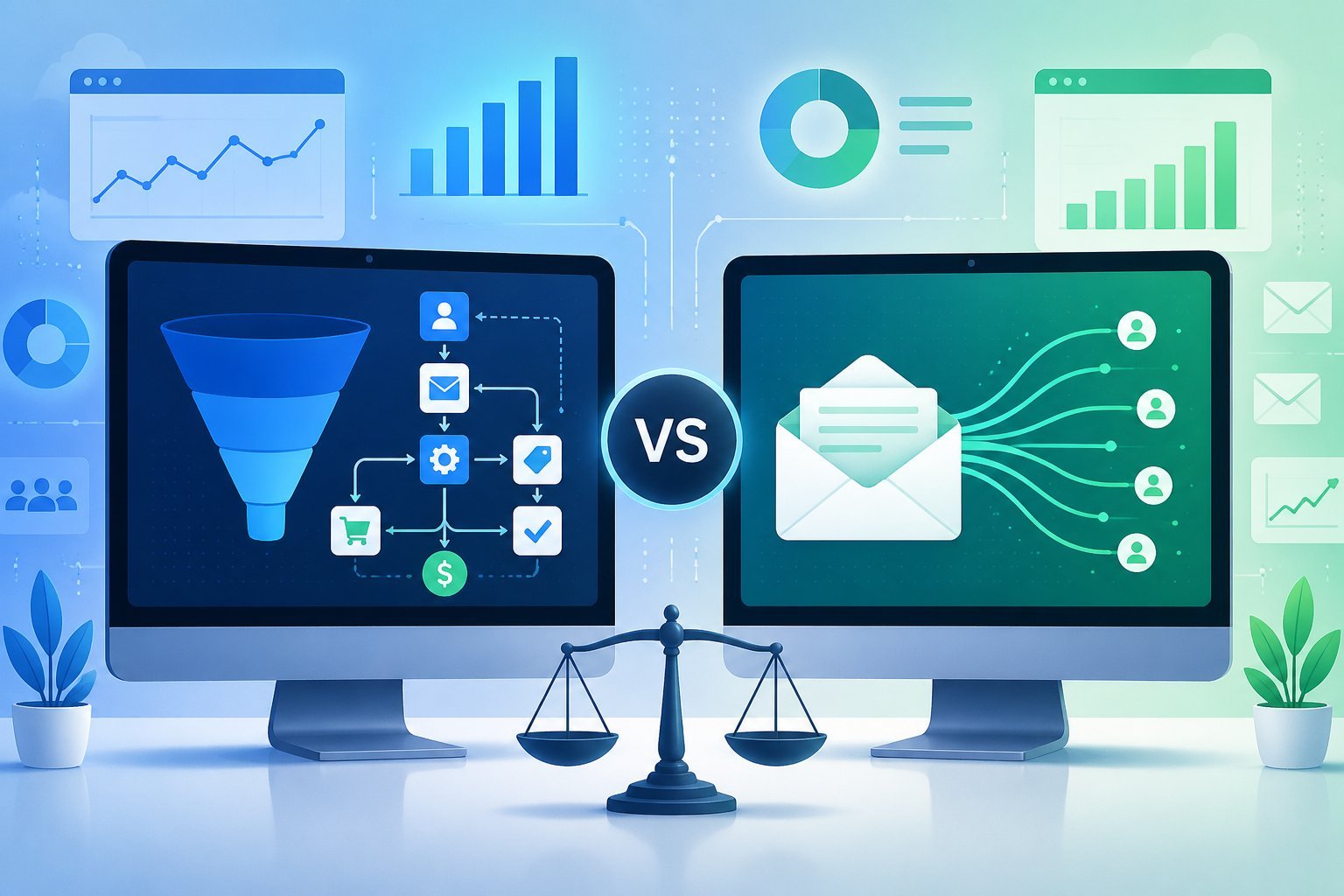
ConvertKit excels at email marketing automation with tools built specifically for creators. ClickFunnels focuses more on sales funnels with basic email features.
ConvertKit offers advanced subscriber segmentation and visual automation builders. ClickFunnels provides simpler email tools that work within its funnel system.
Email Sequences and Campaigns
ConvertKit gives you powerful tools for creating automated email sequences. You can build complex email series that send based on subscriber actions, making it easy to nurture your audience over time.
The platform lets you create both automated sequences and one-time broadcasts to your email list. ClickFunnels includes email marketing features, but they’re more basic.
You can send follow-up sequences within your funnels and create simple automated email sequences. The tool works well for sales-focused messages but doesn’t match ConvertKit’s depth for content creators.
ConvertKit charges based on your subscriber count, starting at $29 per month. ClickFunnels costs $81 per month and includes email tools as part of the complete funnel builder.
If email marketing is your main focus, ConvertKit’s specialized features give you more options for engaging subscribers.
Automation Workflows and Visual Automation
ConvertKit’s visual automation builder lets you create workflows by dragging and dropping different actions and triggers. You can see your entire automation flow on one screen, making it simple to build complex sequences.
The platform tracks subscriber behavior and automatically moves people through your workflows based on what they do. ClickFunnels offers automation within its funnel builder but without the same visual workflow capabilities.
You set up email sequences that trigger at specific points in your funnels. The system works fine for basic needs but lacks the flexibility of ConvertKit’s visual automation tools.
Both platforms integrate with Zapier, which expands your automation options. ConvertKit’s automation workflows are designed for email marketing, while ClickFunnels focuses on moving people through sales funnels.
Subscriber Segmentation and Tags
ConvertKit uses a tag-based system for subscriber segmentation. You can add multiple tags to subscribers based on their interests, actions, or behaviors.
This approach gives you flexibility to organize your email list in ways that make sense for your business. ClickFunnels provides basic subscriber management within its funnel system.
You can segment people based on which funnels they enter and what actions they take. The tool doesn’t offer the same detailed tagging options as ConvertKit.
ConvertKit lets you combine tags and segments to send targeted messages. You might tag subscribers who click specific links or complete certain actions.
ClickFunnels keeps subscriber data tied to individual funnels, which works well for sales but limits broader email marketing strategies.
Email Templates and Deliverability
ConvertKit provides simple email templates that focus on plain text and basic formatting. This approach often improves deliverability rates because emails look more personal and less like marketing messages.
The platform maintains strong sender reputation to help your emails reach inboxes. ClickFunnels includes email templates designed for sales and promotions.
The templates integrate with landing pages and funnels you create in the platform. Both tools handle basic email deliverability, but ConvertKit’s email marketing platform specialization means they focus more on maintaining high deliverability rates.
Your choice depends on your email marketing tools needs. ConvertKit gives you better deliverability and more professional email marketing features.
ClickFunnels works when you need email tools that connect directly to your sales funnels.
E-Commerce and Monetization Features
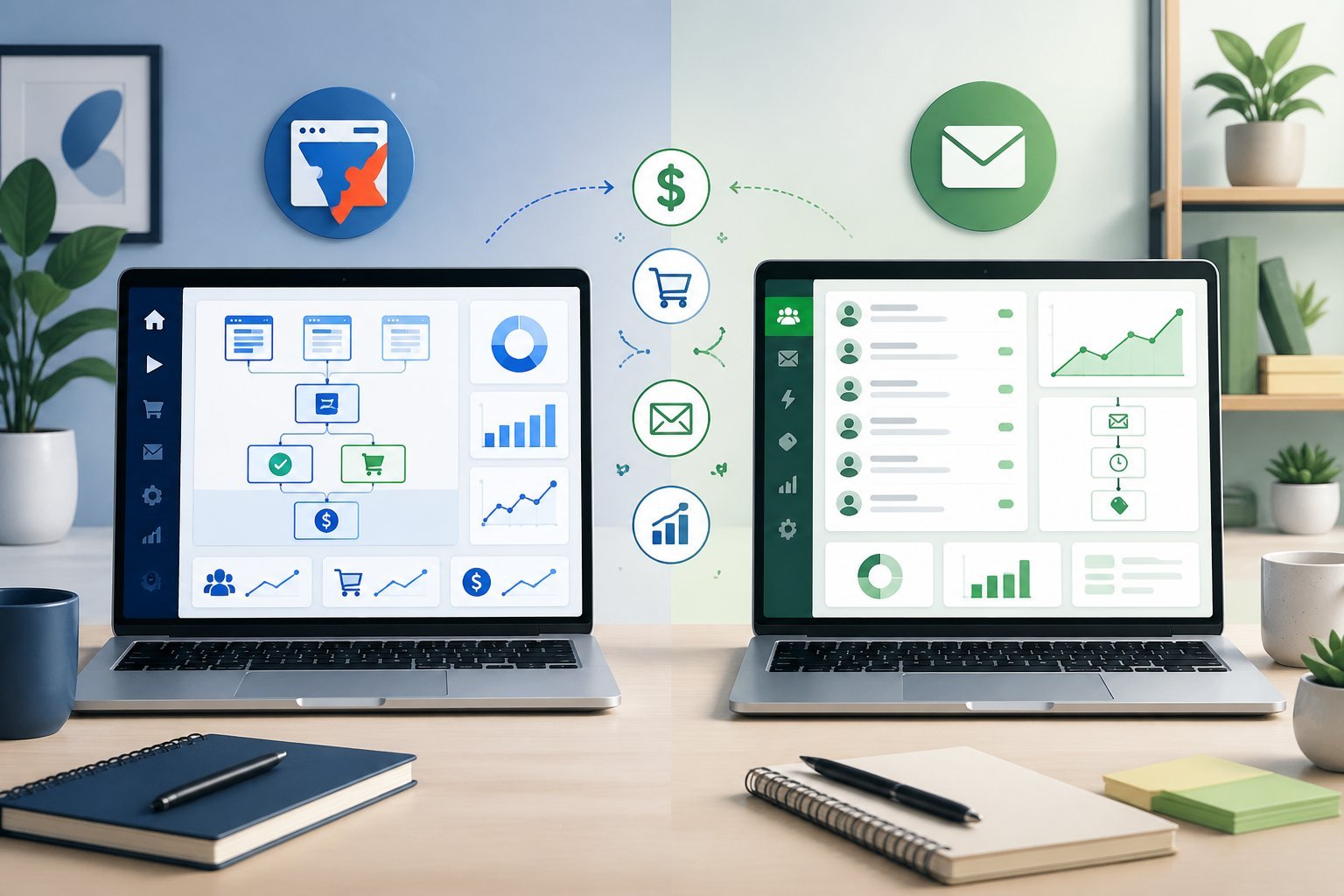
ClickFunnels provides a full suite of e-commerce tools for selling products and maximizing revenue. ConvertKit focuses on creator monetization through email-based product sales and paid newsletters.
Selling Digital and Physical Products
ClickFunnels lets you sell both digital products and physical products through its platform. You can create product pages, manage inventory, and deliver digital downloads automatically after purchase.
The system handles everything from simple one-product sales to complex product catalogs. ConvertKit allows you to sell digital products like ebooks, guides, and downloads directly through email campaigns and landing pages.
The platform works well for creators who want to monetize their audience with digital offerings. However, it doesn’t support physical products or traditional e-commerce functionality.
If you need to sell physical items, you’ll need to integrate with Shopify or use a different platform.
Checkout, Payments, and Order Bumps
ClickFunnels provides customizable checkout pages with built-in payment gateways including Stripe and PayPal. You can create multi-step checkout pages or single-page order forms depending on what converts best for your business.
The platform supports order bumps, which let customers add extra items to their purchase with a single click right on the checkout page. ConvertKit offers basic checkout functionality through Stripe integration for selling digital products.
The checkout experience is simpler and more limited compared to ClickFunnels. You won’t find order bumps or advanced checkout customization options.
The payment system works fine for straightforward product sales but lacks the conversion-focused features that dedicated sales funnel software provides.
Membership Sites and Online Courses
ClickFunnels includes built-in tools for creating membership sites where you can deliver online courses and exclusive content to paying members. You can set up different membership levels, drip content over time, and manage recurring subscriptions.
Members get login credentials to access their content through a secure member area. ConvertKit doesn’t offer membership site functionality.
You can use it to send course content via email sequences, but you won’t have a dedicated member portal or login system. Creators who want to host courses typically integrate ConvertKit with platforms like Kajabi or Teachable to handle the actual course delivery while using ConvertKit for email marketing.
Upsells, Downsells, and Sales Pages
ClickFunnels excels at maximizing revenue through upsells and downsells. After someone completes their purchase, you can offer them additional products with one-click upsells that don’t require re-entering payment information.
If they decline, you can present a downsell with a lower-priced alternative. The platform includes templates for high-converting sales pages designed specifically to sell products.
ConvertKit doesn’t have upsell or downsell capabilities. You’re limited to promoting additional products through follow-up emails after the initial purchase.
The platform offers basic landing page templates that can function as sales pages, but they lack the advanced conversion elements and testing features found in ClickFunnels.
Integrations, Analytics, and Scalability

Both platforms connect with external tools differently and track performance through distinct analytics systems. Your choice depends on which integrations you need and how much data visibility matters for your business.
Third-Party Integrations and API
ClickFunnels offers native connections to payment processors, email services, and CRM platforms. You can link Shopify for product fulfillment and connect your favorite payment gateways directly.
The platform includes integrations with popular tools like Mailchimp and various webinar software. ConvertKit focuses on creator-friendly integrations.
You get direct connections to e-commerce platforms, membership sites, and course builders. The API allows developers to build custom solutions when needed.
Both platforms work with Zapier, which opens up thousands of additional integration possibilities. This means you can connect either tool to CRM systems, including GHL (GoHighLevel), even if there’s no native integration.
ClickFunnels tends to have more built-in sales and checkout integrations, while ConvertKit specializes in content creator tools.
Analytics and Conversion Tracking
ClickFunnels provides detailed funnel analytics that show you exactly where visitors drop off. You can track conversion rates at each step of your sales process.
The A/B testing feature lets you compare different page versions to improve performance. ConvertKit gives you email-focused metrics like open rates, click rates, and subscriber growth.
You can see which emails drive the most engagement. The platform tracks subscriber behavior across your automations.
ClickFunnels excels at sales metrics and revenue tracking. ConvertKit focuses on audience engagement and email performance.
Neither platform offers the depth of Google Analytics, but both cover essential metrics for their core functions.
Platform Scalability and Performance
ClickFunnels handles high-traffic sales funnels without slowdowns. The platform manages large product catalogs and processes thousands of transactions.
You can scale from a few hundred visitors to tens of thousands without switching platforms. ConvertKit grows with your email list size.
The platform handles lists from 1,000 to over 100,000 subscribers smoothly. Performance stays consistent as your audience expands.
Both platforms charge based on usage. ClickFunnels pricing increases with features and funnels you need.
ConvertKit pricing scales with your subscriber count. Your costs will grow as your business expands on either platform.
Pricing, Free Plans, and Value for Money
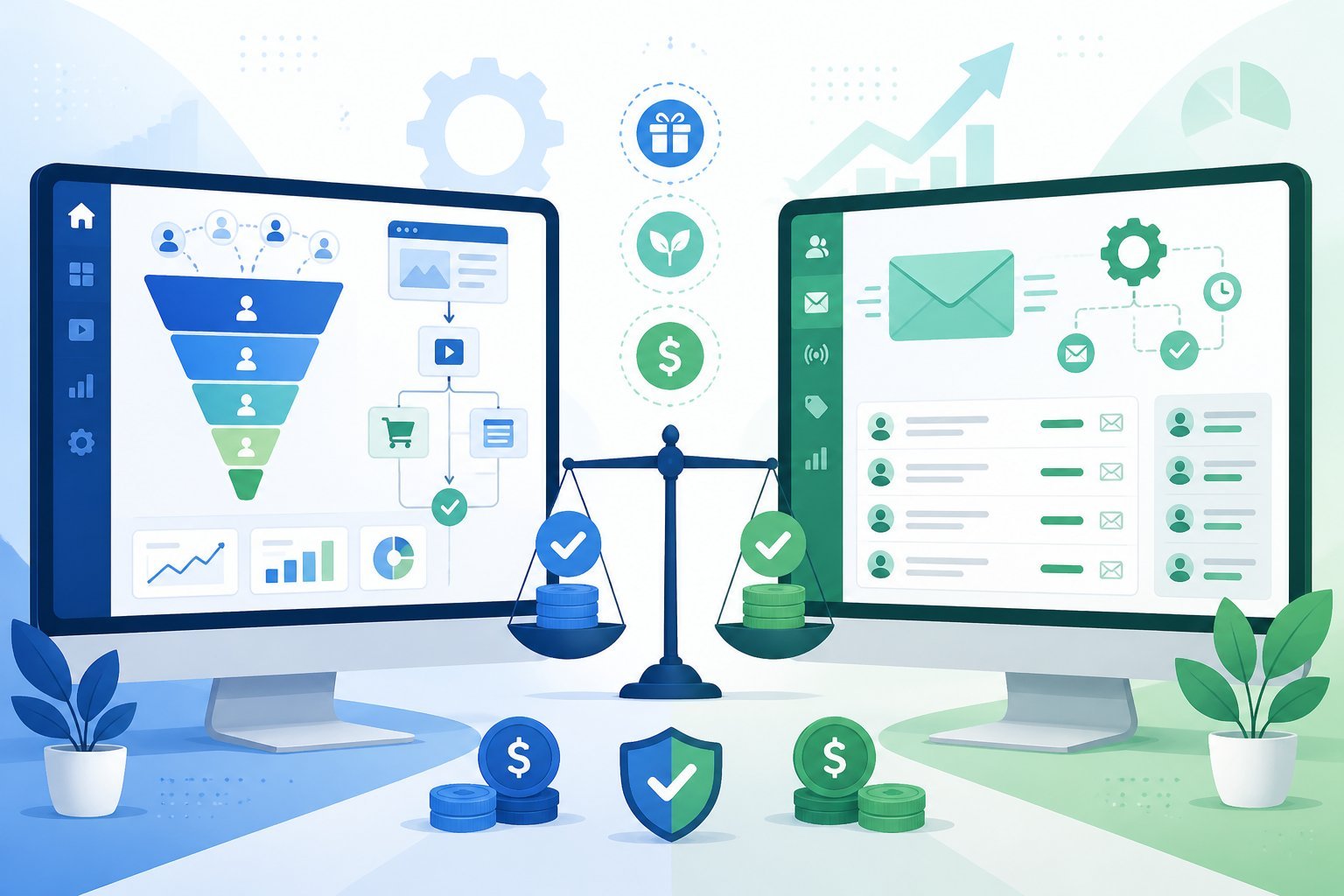
ClickFunnels and ConvertKit have very different pricing structures that reflect their different purposes. ClickFunnels costs more but offers broader tools, while ConvertKit provides a free plan and lower entry prices for email-focused creators.
Pricing Structures and Tiers
ClickFunnels pricing starts at $81 per month for basic features with 2 team members. This price stays the same whether you have 2,500 or 25,000 contacts.
Once you reach 100,000 contacts, the price jumps to $248 per month. The full feature plan costs $500 per month.
ConvertKit pricing works differently because it’s based on your list size. You’ll pay $29 per month to start with fewer contacts.
For 2,500 contacts, you’ll pay $41 per month. As your list grows, pricing increases: $100 per month for 10,000 contacts, $199 per month for 25,000 contacts, and $679 per month for 100,000 contacts.
The pricing difference becomes clear when you compare contact tiers. At 10,000 contacts, ClickFunnels costs $81 while ConvertKit costs $100.
But at 100,000 contacts, ClickFunnels jumps to $248 while ConvertKit reaches $679.
Free Trial and Free Plan Options
Both platforms offer a 30-day money-back guarantee. ConvertKit goes further by offering a free plan for creators with up to 1,000 subscribers.
This makes it easy to start email marketing without any cost. The free plan gives you access to basic email features and landing pages.
You can test the platform and grow your audience before paying anything. ClickFunnels doesn’t have a free plan, but you can try it risk-free with the 30-day refund policy.
Value for Creators, Marketers, and Businesses
ClickFunnels delivers better value if you need sales funnels, membership sites, and split testing. The $81 starting price includes hosting, SSL, analytics, and email marketing.
You get an all-in-one platform instead of paying for multiple tools. ConvertKit offers better value for bloggers and content creators who focus on email marketing.
The free plan helps you start without investment. Paid plans cost less than ClickFunnels at lower contact levels, making it budget-friendly for growing audiences.
You also get unlimited users on higher plans, while ClickFunnels requires plan upgrades to add team members.
Customer Support and Community Resources
ConvertKit offers 24/7 support for all paid users, while ClickFunnels provides tiered support based on your plan level. Both platforms give you access to learning materials and active communities, though they take different approaches to helping you succeed.
Onboarding and Migration Assistance
ConvertKit provides free white glove migration services to help you move your email list from another platform. A team member will handle the technical work of transferring your subscribers, tags, and segments.
This is helpful if you’re a blogger or creator switching from another email tool. ClickFunnels gives you access to onboarding resources through video tutorials and setup guides.
You’ll need to build your funnels yourself using their templates and training materials. The platform starts you with 2 team members on the basic plan, so you can bring in help if needed.
Both platforms offer 30-day refund policies. This gives you time to test the software and complete your migration before committing long-term.
Learning Resources and Documentation
ClickFunnels provides extensive training through tutorials, webinars, and documentation. You can attend their annual Funnel Hacking Live event to learn advanced strategies.
The platform focuses heavily on sales funnel education for course creators and marketers. ConvertKit offers a knowledge base with articles and video guides focused on email marketing.
The resources are simpler and more direct than ClickFunnels. You’ll find content about automation, landing pages, and audience building for creators and bloggers.
Support and Community Engagement
ConvertKit gives you 24/7 customer support through email on all paid plans. You won’t get live chat, but responses typically come within a few hours.
The platform has a smaller but focused community of bloggers and creators. ClickFunnels uses email ticket support during business hours with response times that vary by plan level.
Higher-tier plans get faster responses. The platform has active user forums and Facebook groups where marketers and course creators share strategies.
These communities are larger and more active than ConvertKit’s, giving you more networking opportunities.
Choosing the Right Platform for Your Needs
The best choice between ClickFunnels and ConvertKit depends on your main business goal. If you need to build sales funnels and convert leads, ClickFunnels works better.
If email marketing is your priority, ConvertKit is the stronger option.
Summary of Key Strengths
ClickFunnels excels at:
- Building high-converting sales funnels with proven templates
- Creating complete customer journeys from lead magnet to purchase
- Running upsells and cross-sells automatically
- Selling multiple product types (digital, physical, courses)
- Hosting membership sites
- Managing the entire sales process in one place
ConvertKit excels at:
- Email automation and subscriber management
- Building relationships with your audience through newsletters
- Organizing contacts with tags and segments
- Designing simple landing pages for lead magnets
- Tracking email performance metrics
- Keeping email marketing affordable as your list grows
Both platforms integrate with other tools. You can use them together or pick one based on what your business needs most right now.
Who Should Use ClickFunnels
ClickFunnels fits best if you sell products or services and need a system for lead generation and sales. You should choose ClickFunnels if you want to create high-converting funnels with multiple steps.
Product-based businesses benefit most from ClickFunnels. If you sell courses, coaching, physical products, or software, the funnel templates help you convert visitors into buyers.
The platform works well when you need order bumps, upsells, and downsells built into your sales process. You also need ClickFunnels if you run webinars or product launches.
The platform includes templates specifically designed for these types of campaigns. You can build entire registration and sales sequences without hiring a developer.
Choose ClickFunnels if you want everything in one place. Instead of connecting five different tools, you get page building, checkout pages, membership areas, and basic email features all together.
Who Should Use ConvertKit
ConvertKit works best for creators who focus on email marketing and audience building. You should pick ConvertKit if you send regular newsletters, run automated email sequences, or need advanced subscriber management.
Bloggers, podcasters, and content creators get the most value from ConvertKit. The platform makes it easy to send broadcasts to your whole list or specific segments.
You can tag subscribers based on their interests and send them relevant content. You need ConvertKit if email automation is your main marketing strategy.
The visual automation builder lets you create sequences that respond to subscriber actions. When someone clicks a link or downloads a lead magnet, you can trigger different email paths.
Pick ConvertKit if you want affordable email marketing that grows with you. The pricing scales based on your subscriber count.
You get powerful features without paying for funnel-building tools you might not use.
Combining Both for a Complete Solution
Using ClickFunnels and ConvertKit together gives you the best of both platforms. Many businesses integrate both tools to handle different parts of their marketing.
You can use ClickFunnels to build high-converting sales funnels and landing pages for your lead magnets. When someone opts in through your funnel, their information goes directly to ConvertKit.
ConvertKit handles all your email marketing, automation, and subscriber management. ClickFunnels focuses on converting visitors and making sales.
The integration between the two platforms is simple to set up. You connect your accounts once, and subscriber data flows automatically.
You don’t need technical skills to make them work together.